Atomic DvP, settled privately: Linea and Bermuda demonstrate trustless private interoperability across chains

Linea.Build
 June 15, 2026
Two key challenges for Tokenized finance
Tokenized securities, tokenized deposits, and regulated stablecoin-like bank money are moving from pilots into production roadmaps. But institutions keep hitting two requirements that today's infrastructure rarely satisfies at the same time.
The first is interoperability: assets and cash legs live across custodians, venues, private ledgers, and public chains. The second is privacy with compliance: positions, counterparties, and pricing are sensitive, and the default transparency of public chains is unworkable for many institutional flows. Fully private chains solve privacy, by giving up connectivity.
The cost of fragmented settlement is measurable. Settlement fails in T2S generated roughly €633 million in penalties in one year (ECB TARGET Services Annual Report 2024). DTCC estimated that moving from T+2 to T+1 would cut the volatility component of NSCC margin by about 41%: roughly $3 billion (DTCC, 2021).
Private, trustless, atomic: DvP across chains
Linea and Bermuda have built a proof of concept for trustless private interoperability across chains, using atomic delivery versus payment (DvP) as the use case.
One party delivers tokenized security and the counterparty delivers tokenized cash. Both legs settle in a single conditional workflow: either both settle, or neither does. Because the two legs cannot separate, there is no principal risk and banks no longer need to prefund accounts or fix reconciliation breaks afterwards.
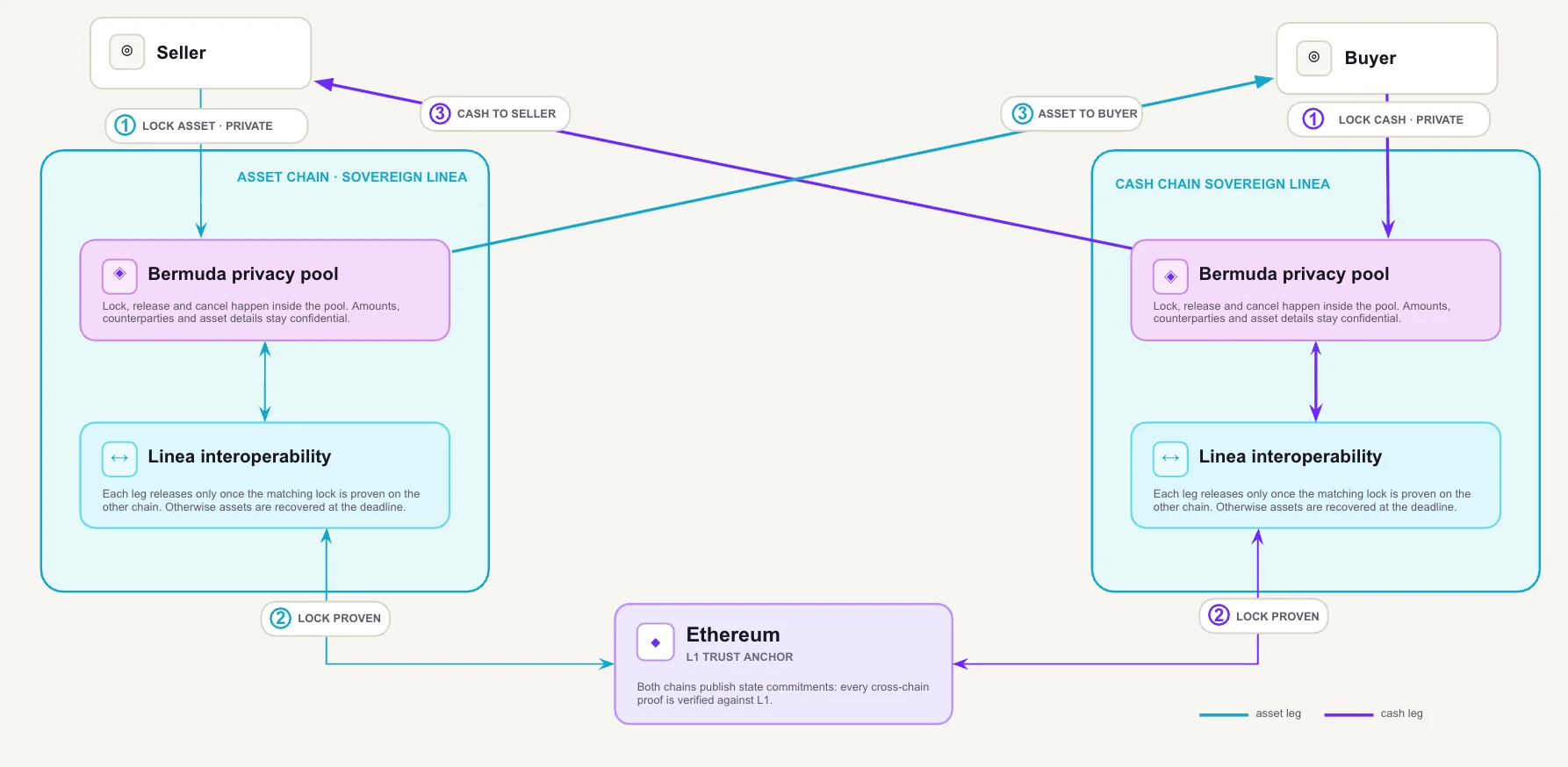
Lineth already supports confidentiality through RBAC: the operator manages the ledger and decides who sees what. That model fits deployments where a regulated operator is meant to have full visibility as a bank running its own network, for example.
For settlement between organizations, access controls on both networks can be enough. But some workflows reach environments where access controls do not apply: settling one leg on a public chain, for example. Those cases need privacy at the user level, and that is what Bermuda's privacy layer addresses: amounts, counterparties and positions are not accessible to anyone, not even an operator, while settlement remains cryptographically verifiable by the parties who need to verify it..
How the pieces fit together
→ Linea provides Lineth, its zkEVM stack. The environment where both legs settle, with native cross-chain interoperability between ledgers, secured by zero-knowledge proofs.
→ Bermuda provides the privacy layer
Bermuda contributes the privacy layer and the private interoperability components that connect organizations across private and public chains.
An open model for private interoperability
Most attempts to give institutions onchain privacy share a structural choice: build a closed environment and accept isolation as the price of confidentiality. That model holds until an institution needs to settle with a counterparty outside the walls.
Lineth provides a solution for permissioned and private ledgers to upgrade their existing network and enable them to connect to other EVM networks.
The combination of Bermuda's privacy layer and Lineth creates private interoperability with other networks: institutions can still settle with counterparties on those networks, but the details of those transactions are no longer exposed. Participants are known and approved, as regulation requires. Each institution decides which transaction details are shared and who sees them: the counterparty, a regulator, no one else.
Why now
Financial markets are increasingly moving toward tokenized infrastructure: banks, FMIs, asset managers and payment networks are exploring how deposits, securities and regulated assets can move onchain. But tokenization will not happen on a single network, or inside one closed environment. Different institutions will operate different ledgers, with different rules, privacy requirements and governance models.
This creates a new infrastructure challenge: how can regulated institutions connect across networks without exposing sensitive data, losing control over access, or creating new settlement risk? The proof of concept shows that this is possible: tokenized securities and tokenized cash can settle atomically across EVM chains, while transaction details remain private and correctness remains verifiable.
Beyond DvP
The same combination of atomic settlement and verifiable privacy extends to payment versus payment for FX, where the BIS estimates roughly $2.2 trillion per day of deliverable turnover remains exposed to settlement risk, as well as collateral mobility, intraday repo, compliance workflows, and selective integrations with permissionless DeFi under institutional controls.
Sources:
ECB TARGET Services Annual Report 2024 – T2S settlement fail penalties (€633M/year).
DTCC, “Leading the Industry to Accelerated Settlement” (2021) – T+2→T+1, ~$3B / −41% NSCC volatility-component margin estimate.
BIS Quarterly Review, “FX settlement risk” (2022) – ~$2.2T/day deliverable FX turnover exposed to settlement risk.
Latest Articles
All articles


Linea Exponent: Program Conclusion & Final Update
We're publishing this post to formally close out the Linea Exponent program, provide a full account of outcomes, and make sure every participating team and their communities has the clear, factual information they need.
May 13, 2026
Building a credible neutral infrastructure: Linea Stack joins Linux Foundation Decentralized Trust as Lineth
The open-source ZK rollup stack that has powered Linea Mainnet since 2023 is being contributed to Linux Foundation Decentralized Trust as a new incubating project: Lineth.
May 5, 2026

Small Fields – Faster Proving on Linea, Toward Real-Time Finality
We’ve reduced proof generation latency, a decisive step toward real-time proving, while significantly cutting RAM requirements. These gains come from a fundamental re-architecture of how we prove Ethereum state, with zero compromise on security.
April 9, 2026

