Linea Achieves 100 mGas/s Throughput
A Look Inside Linea’s Sequencer Performance Journey

Linea.Build
 February 20, 2026
Today, Linea’s sequencer can sustain over 100 mGas/s in throughput, with peak performance reaching 218 mGas/s on ERC-721 transactions—positioning Linea among the highest performance, institutional grade L2 sequencers in the ecosystem.
This milestone represents months of systematic optimization, rigorous load testing, and architectural improvements. An important by-product of our systematic approach is the identification of bottlenecks through profiling, fixing regressions, and validating with rigorous load testing—giving the team a clear roadmap for continued improvements.
This is how we got here.
Understanding the Linea Sequencer Architecture
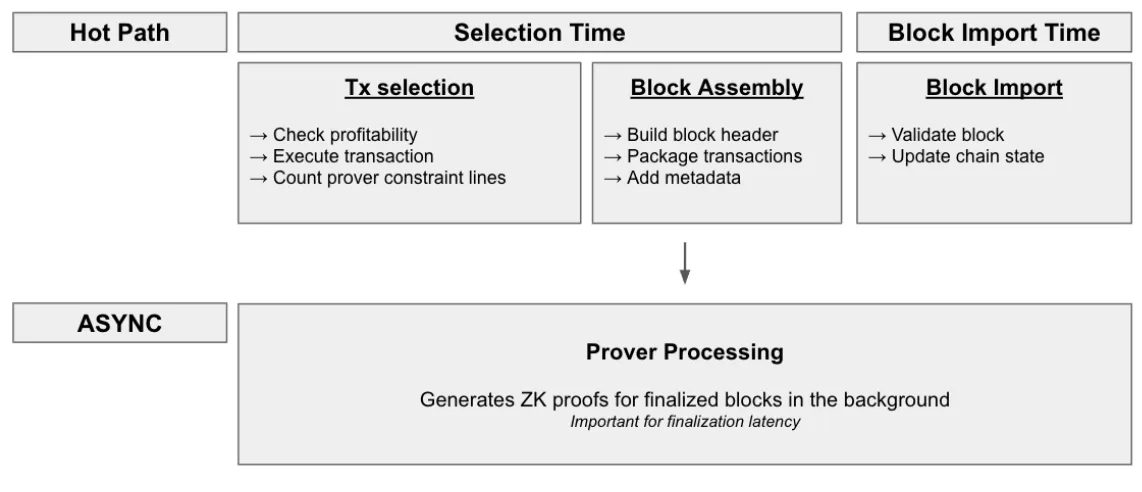
Linea’s block production follows a streamlined pipeline where understanding what happens sequentially (the “hot path”) versus asynchronously is key to optimizing performance.
When building a block, the sequencer must execute these steps in sequence:
Transaction selection: The sequencer pulls transactions from the mempool and evaluates each one, checking profitability, executing the transaction, and counting constraint lines for the prover.
Block assembly: Once transactions are selected, the block is assembled with headers and metadata.
Block import: The finalized block is imported into the chain state.
This sequential flow means that selection time + block import time directly determines our maximum throughput.
The Asynchronous Component: Prover Time
Unlike the hot path, proving happens asynchronously. The prover processes finalized blocks in the background without blocking new block production. This architectural decision means prover efficiency, while important for finalization latency, doesn’t bottleneck real-time throughput.
Our Load Testing Methodology
We conducted extensive load testing across multiple releases, running tests on a performance devnet with m7a.8xlarge instances.
Deterministic Load Approach
We used deterministic load that creates full blocks of the same transaction type, which simplifies the analysis across different releases and ensures consistent, comparable results.
Transaction Types Tested
Simple ETH transfers, ERC-20 token transfers, ERC-721 NFT mints, and TGE contract transactions.
Key Metrics Measured
→ Selection time: time to select and execute transactions for inclusion. → Block import time: time to import the produced block into chain state. → Throughput (mGas/s): extrapolated million gas units processed per second.
Testing Parameters Maximum block gas size: 200 mGas/s (vs. mainnet limit of 60 mGas/s) Block time: 2 seconds Maximum number of transaction per block on Linea mainnet: 300 L2 block size limit (bytes): 120,000 (aligned with 128 KiB L1 blob size)
Benchmark Results Important note on test configurations: we present results from two test configurations below. The “Production Configuration” includes block import time in throughput calculations, representing real-world performance. The “Peak Sequencer Capacity” measures selection time only, showing raw sequencer capability with the 300 transaction per block cap removed.
Production Configuration (Limitless Prover, v3.1-rc6) This configuration uses limitless prover (light line counting enabled) and includes both selection time and block import time in throughput calculations.
Transaction Type | Mean Tx Selection Time (ms) | Mean Block Import Time (ms) | Max Throughput (1s) | Max Throughput (2s) | Max TPS |
Simple Transfers | 222.32 | 19.1 | 79.5 mGas/s | 159 mGas | 456 |
ERC-20 | 194.84 | 30.2 | 96.4 mGas/s | 192.8 mGas | 306 |
ERC-721 (Mints) | 608.31 | 92.82 | 83.4 mGas/s | 166.8 mGas | 231 |
TGE Contract* | 627.06 | 146.8 | 61.7 mGas/s | 123.4 mGas | 352 |
*TGE testing had a limited sample size (15 blocks) due to stability challenges under extreme loads.
Peak Sequencer Capacity (v4.0-rc23, no transaction cap) To test raw sequencer capability, we removed the 300-transaction-per block cap and measured selection time only (excluding block import overhead).
Transaction Type | Throughput (1s) | Throughput (2s) | Max TPS |
Simple Transfers | 79.4 mGas/s | 158.8 mGas/s | 451 |
ERC-20 | 89.5 mGas/s | 179 mGas/s | 306 |
ERC-721 (Mints) | 218 mGas/s | 436 mGas/s | 229 |
ERC-721 mint transactions consume significantly more gas per transaction (~120k gas) compared to ERC-20 transfers (~35k gas). With larger blocks allowed, the higher gas consumption per transaction translates to higher mGas/s throughput despite lower TPS.
What This Means for Institutions, Enterprises and DeFi Builders Sequencer throughput at this level is a critical milestone for anyone evaluating Linea as their execution layer. 100+ mGas/s delivers the predictable, high-capacity performance institutions need to confidently run production workloads with confidence required on L2.
For DeFi protocols, higher throughput translates directly into more transactions settling per block, enabling tighter spreads on DEXs, faster and more reliable liquidation mechanisms, and the execution density needed for sophisticated onchain strategies like high-frequency market making or complex vault rebalancing.
As we continue pushing throughput higher, Linea is building the infrastructure foundation where institutional-grade finance and next-generation DeFi can coexist at scale.
What’s Next: Pushing Beyond 100 mGas/s Continuing to reduce the overhead of counting constraint lines on selection time. This is needed for the prover, it is continuously optimized to have a good balance between accurate approximation and performance overhead.
Limitless Prover: No need for line counting step during transaction selection.
Continued Performance Testing With sequencer performance now proven at 100+ mGas/s, and block size already increased to 60 mGas in December 2025, we’ll continue validating performance under real-world conditions as we prepare for further block limit increases. We are aiming to significantly increase our gas limit on our block size during the year 2026.
The data shows that our sequencer is no longer the limiting factor for throughput. It’s worth noting that these results reflect block building performance, which includes Linea specific features like line counting for the prover. When we benchmark raw client execution performance without this overhead, Besu achieves approximately 350 mGas/s, demonstrating significant headroom as we continue optimizing our sequencer specific components.
As we roll out the optimizations identified through this testing, users can expect even better performance in the months ahead.
Latest Articles
All articles


Atomic DvP, settled privately: Linea and Bermuda demonstrate trustless private interoperability across chains
A joint proof of concept shows tokenized assets and cash settling atomically across EVM chains – sensitive details stay private, settlement stays verifiable.
June 15, 2026

Linea Exponent: Program Conclusion & Final Update
We're publishing this post to formally close out the Linea Exponent program, provide a full account of outcomes, and make sure every participating team and their communities has the clear, factual information they need.
May 13, 2026
Building a credible neutral infrastructure: Linea Stack joins Linux Foundation Decentralized Trust as Lineth
The open-source ZK rollup stack that has powered Linea Mainnet since 2023 is being contributed to Linux Foundation Decentralized Trust as a new incubating project: Lineth.
May 5, 2026

