

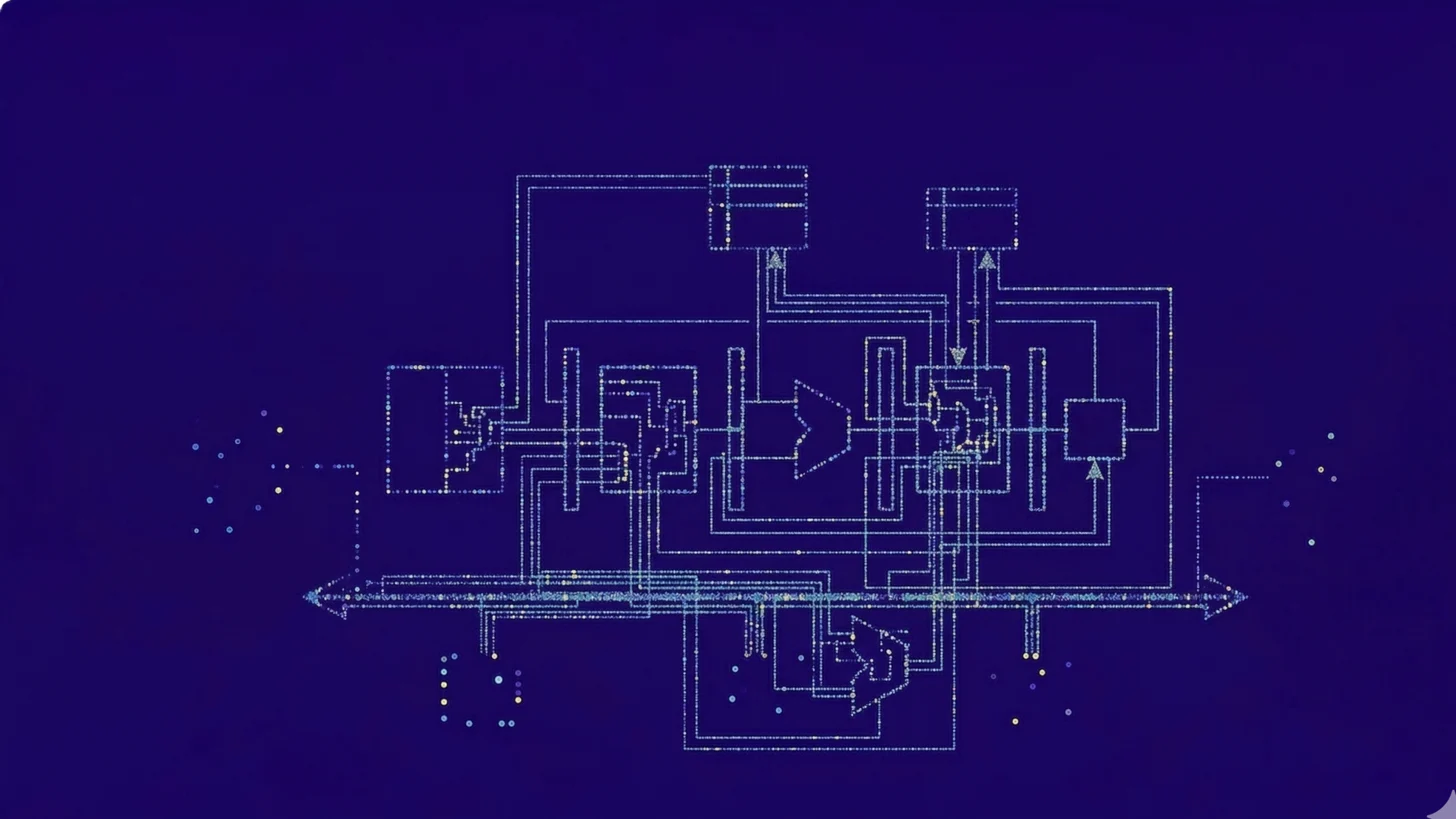
For the past several years, Linea’s cryptography team has directly arithmetized the EVM, manually translating every opcode into mathematical constraints our prover could verify.
That achievement got us to Mainnet, produced a 1,000+ page specification that became a reference for the ecosystem, and built a depth of EVM knowledge.
But that same approach was holding us back. Every Ethereum hard fork meant rewriting constraint modules. The interdependencies between components made routine upgrades error-prone. We had a world-class research team spending its energy fighting complexity instead of pushing the frontier.
A simpler machine, a faster prover
Where the EVM has a complex, dynamic state model, RISC-V gives you 32 registers and approximately 40 instructions. For a proving system, the practical impact is immediate: traces become narrower, can be built in real time, and the prover can start working on proof chunks immediately.
RISC-V also solves our biggest compatibility gap. Today, Linea uses Poseidon instead of Keccak and has its own state representation. Achieving Type-1 Ethereum compatibility through direct arithmetization would have meant implementing Keccak, RLP, and the Merkle Patricia Trie by hand in constraints. With RISC-V, you compile a standard EVM client to a RISC-V binary, and the compiler handles all of it. Type-1 compatibility from day one.
Ethereum Foundation’s vision
Linea does not simply sit atop L1; it exists to build and develop the Ethereum vision. The Ethereum Foundation commitment to RISC-V is the clearest signal yet about what the proving layer of Ethereum will look like, and which systems will be viable candidates for the enshrined rollup. Continuing on our previous path would have meant diverging from the L1 roadmap. That was a line we weren’t willing to cross.
And the timing works in our favor. We’ve already proven we can ship a production system. We know the target instruction set, the security requirements, the architecture. The entire ecosystem is converging on the same foundation and we arrive with years of proving experience that directly applies. Large opportunities are opening up right now, and we intend to move fast.
New Architecture, Same DNA
None of what we’ve built gets left behind. zkC, our constraint-native language will write the RISC-V VM. Vortex and Arcane, our proving and aggregation stack, are architecture-independent. We’re also building formal verification compatibility from day one, designing constraints to be exportable to tools like Lean from the start.
The new architecture introduces true modularity: every layer can be independently benchmarked, audited, or swapped. Our prover team can push performance optimizations without touching the arithmetization. If a better hashing approach emerges, we integrate it without cascading rewrites. That's a fundamentally different proposition from the tightly coupled system we have today.
Linea has one of the most experienced proving teams in the Ethereum ecosystem and one of the only projects with full-stack ownership, from the execution client (Besu) to the consensus layer (Maru) to the ZK prover and the gateway. Everything is in-house, no critical third-party dependency. For years, that expertise was channeled into the hardest version of the problem. Now we’re applying it to a simpler, more powerful architecture, one that unlocks the performance, compatibility, and verifiability that both the ecosystem and the enterprise building on it demand.
Why Now and What’s Next
This is where the choice of RISC-V goes beyond performance of Ethereum alignment. Direct EVM arithmetization was, by nature, a highly specialized system, difficult to extend, difficult to audit without deep mathematical and cryptographic expertise, and ultimately difficult to anyone outside our team to contribute to.
RISC-V changes that fundamentally. It’s a well documented, widely taught instruction set with a growing ecosystem of tooling and developers. A proving stack built on RISC-V isn’t just easier for us to maintain, it’s a stack that the broader community can reason about, review, and help improve. The move to RISC-V makes that vision practical in a way it never was before: a modular, standards-based architecture that can live beyond any one team.
By making this move, we’re rethinking who the stack belongs to. More on this very soon.
Latest Articles
All articles


Atomic DvP, settled privately: Linea and Bermuda demonstrate trustless private interoperability across chains
A joint proof of concept shows tokenized assets and cash settling atomically across EVM chains – sensitive details stay private, settlement stays verifiable.
June 15, 2026
Linea Exponent: Program Conclusion & Final Update
We're publishing this post to formally close out the Linea Exponent program, provide a full account of outcomes, and make sure every participating team and their communities has the clear, factual information they need.
May 13, 2026
Building a credible neutral infrastructure: Linea Stack joins Linux Foundation Decentralized Trust as Lineth
The open-source ZK rollup stack that has powered Linea Mainnet since 2023 is being contributed to Linux Foundation Decentralized Trust as a new incubating project: Lineth.
May 5, 2026

