
Many exploring blockchain face three recurring barriers: operational complexity, custody risk and compliance controls. Linea now enables programmable account controls that address all three, without changing existing wallet infrastructure. Multi-step transaction flows collapse into single executions. Delegation is scoped, auditable and revocable in one transaction.
What’s Changed
For years, Ethereum users have faced a choice: use a standard private key account (known in Ethereum as an externally owned account, or EOA) or deploy a smart contract wallet with enhanced capabilities. An Ethereum protocol upgrade, EIP-7702, eliminates this tradeoff entirely.
With a new transaction type introduced by this upgrade, an existing private key account can temporarily delegate its authority to smart contract logic, similar to granting a limited power of attorney. No new address, no migration, no complexity – just enhanced functionality when you need it.
The mechanism is straightforward: the account holder signs an authorization that points your account to a delegate contract (the code that defines exactly what the delegated party can do). The network executes that contract’s logic while preserving the original account’s context, storage and identity. The delegation can be revoked at any time in a single transaction.
New Powers Enabled for Everyone
For institutions, this unlocks programmable compliance: hardware wallets that can delegate specific daily swap limits to a hot wallet, multi-signature approval workflows without a separate smart contract deployment, and controlled access patterns that satisfy enterprise security requirements. Also, delegation does not transfer ownership or custody of funds. The original key holder retains full control and can revoke any delegated logic in a single transaction. Permissions can be scoped by amount, function, time window or counterparty. Delegation cannot exceed the limits defined in the delegate contract, onchain logic enforces boundaries regardless of what the delegated party attempts. If delegated code encounters a failure condition, the transaction reverts and no state changes occur. All rules are enforced onchain and publicly auditable.
For developers, it means you can design onboarding flows that feel like Web2, no approval popup, no confusing multi-step prompts, while still being entirely onchain and non-custodial. Because EIP-7702 is fully compatible with ERC-4337, the existing Ethereum standard for smart account infrastructure, you don’t need to choose between the two. They complement each other: ERC-4337 provides the smart account framework, and EIP-7702 makes it accessible to every existing wallet without migration.
For users, the change is invisible in the best way. Instead of approving a token and then swapping it in two separate transactions, your wallet batches both into one. An app can offer to pay your gas fees so you never need to hold ETH in your account. If you want to grant a friend or an app limited spending rights, say for a subscription that auto-pays monthly, you can do that with fine-grained permissions, revocable at any time.
Basically, your wallet becomes as programmable as a smart contract:
Transaction batching: Execute, approve and swap in a single transaction. No more sequential signatures, no more double gas fees.
Flexible gas payments: Pay fees with mUSD, USDC or any ERC-20 token. Let third-party sponsors cover your gas entirely. Onboard users who’ve never held ETH without friction.
Session keys: Grant time-limited, scoped permissions, similar to scoped API credentials, for trading bots, recurring payments or automated strategies, without exposing your private key. Define exactly what each session can do and when it expires; revocable at any time.
Recovery controls: Implement guardian-based recovery mechanisms and multisig capabilities on addresses you already own. No more “lose your seed phrase, lose everything”.
The Linea Stack Advantage
EIP-7702 is now built into the Linea stack.
Financial institutions can run multi-step issuance workflows for tokenized securities without manual intervention at each stage. DeFi protocols stop losing users at the approval spending screen. Custody providers can extend smart contract capabilities to existing client addresses - already cleared through compliance - with no migration and no additional compliance review required. Linea inherits Ethereum’s full security model. Existing custody providers, tooling and smart contracts work without modification, no proprietary standards required. The result is full compatibility with ERC-4337 infrastructure and native integration with MetaMask.
What’s next
As Ethereum moves toward native account abstraction, Linea gives everyone access to these capabilities. EIP-7702 is just one tool in a larger kit. Going forward, every account abstraction improvement that lands on Ethereum mainnet will be available on Linea.
Future protocol upgrades aim to let accounts fully transition to smart account logic, where the root key can be revoked entirely, enabling trustless multisig governance and institutional-grade key management.
Ethereum is working toward synchronous composability, making the entire ecosystem feel like one chain. In practice, this means access to applications across all chains, unified liquidity and more efficient markets where cross-chain strategies like arbitrage, flash loans and liquidations execute atomically.
Linea is on track to achieve full type-1 EVM compatibility in 2026, meaning complete equivalence with Ethereum’s execution environment, and a front-row seat to each of these capabilities as they go live.
Latest Articles
All articles


Atomic DvP, settled privately: Linea and Bermuda demonstrate trustless private interoperability across chains
A joint proof of concept shows tokenized assets and cash settling atomically across EVM chains – sensitive details stay private, settlement stays verifiable.
June 15, 2026
Linea Exponent: Program Conclusion & Final Update
We're publishing this post to formally close out the Linea Exponent program, provide a full account of outcomes, and make sure every participating team and their communities has the clear, factual information they need.
May 13, 2026
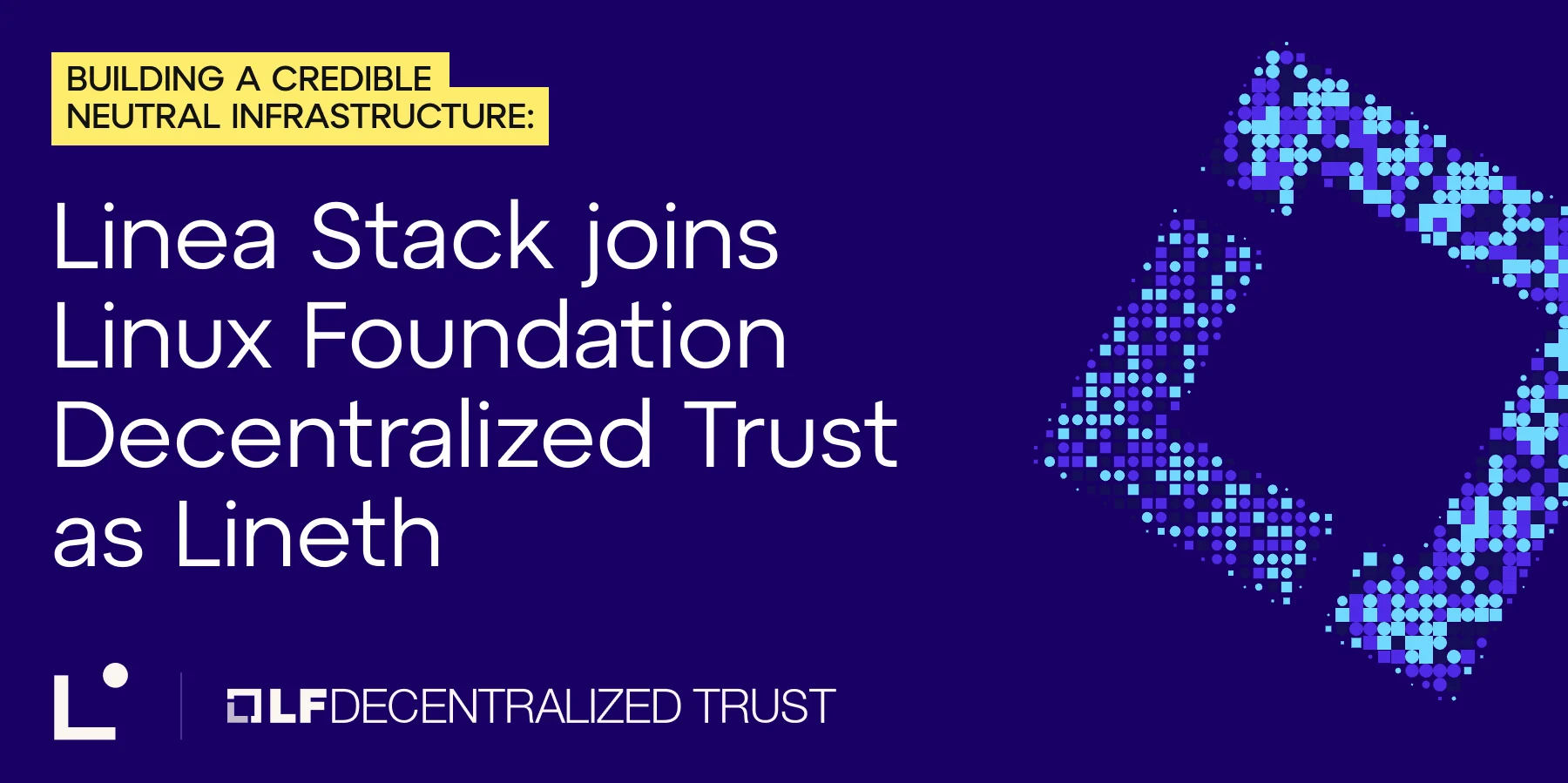
Building a credible neutral infrastructure: Linea Stack joins Linux Foundation Decentralized Trust as Lineth
The open-source ZK rollup stack that has powered Linea Mainnet since 2023 is being contributed to Linux Foundation Decentralized Trust as a new incubating project: Lineth.
May 5, 2026

